7 From Codes to Themes
Where this chapter fits. Step 7 of the research process continues. This chapter covers how codes are grouped into themes, which are the findings of the study.
7.1 A List Is Not a Finding
The researcher from Chapter 6 presents her work to a colleague. She shows the 14 codes and the number of interviews in which each one appears. The colleague studies the list and asks, “So what did you find?”
She starts to answer and stops. Rent increase is a code. Concealment is a code. Each one names something that participants talked about. None of them is a statement that could be true or false. A list of topics does not tell a housing agency what to do differently.
A finding says something about the topics. It connects them, and it can be checked against the transcripts. The step from codes to findings is the search for themes. It is the part of the analysis that depends most on the researcher’s judgment, and so it needs the most discipline.
This chapter uses the same 12 synthetic interviews as Chapter 6. They were written for this book, and no real person said these words.
7.2 What a Theme Is
A theme is a pattern across the data that says something about the research question. Braun and Clarke (2006) describe a theme as capturing something important in the data in relation to that question.
A theme differs from a code in two ways. It is broader, and it usually draws on several codes. It is also a claim. A code names what a passage is about. A theme states what the passages, taken together, show.
A simple test separates a theme from a topic. The noun “help” is a topic. The sentence “Help reaches people only after their situation has become a crisis” is a theme. If a heading in a report could serve as a folder label, it is a topic. Table 7.1 shows the difference.
| Topic | Theme |
|---|---|
| Rent | Costs rise faster than households can adjust to them. |
| Hidden housing | Much housing instability takes forms that no count or program records. |
| Getting help | Help reaches people only after their situation has become a crisis. |
| Relationships | One person with knowledge or authority often decides the outcome. |
7.3 Six Phases
Thematic analysis is a method for finding and reporting themes. Braun and Clarke (2006) describe it in six phases.
- Become familiar with the data. Read everything and write a first memo.
- Generate codes. Code the full dataset.
- Search for themes. Sort the codes into groups that may form themes.
- Review the themes. Check each candidate theme against the coded segments and against the full transcripts.
- Define and name the themes. State each theme in a sentence and decide what it covers.
- Write the report. Present each theme with evidence.
Chapter 6 covered the first two phases. This chapter covers phases 3 through 5, and Chapter 9 covers the report. The phases are not strictly in order. A researcher who reviews a theme in phase 4 often returns to phase 2 to recode.
7.4 Sorting Codes Into Candidate Themes
Phase 3 begins with the codes laid out where they can be moved around. Some researchers write each code on a card. Others use a whiteboard or a spreadsheet.
The researcher looks for codes that belong together and asks what connects them. In the housing study, three codes concerned money. They were Rent increase, Cutting back and debt, and Landlord’s costs. Read together, the segments under these codes described costs that kept rising while incomes stayed fixed. Both tenants and the small landlord described this.
Three other codes concerned situations that were hard to see from outside. They were Doubling up and informal housing, Concealment, and Not knowing. Casey slept in a car and told no one. Devon rented a dining room with no lease. Sasha was housed and afraid of every notice on her door.
Table 7.2 shows how the 14 codes were sorted.
| Theme, stated as a claim | Codes | Interviews |
|---|---|---|
| Costs outrun adjustment. Housing costs rise faster than households, and some landlords, can adjust. | Rent increase. Cutting back and debt. Landlord’s costs. | 9 of 12 |
| Instability that is not counted. Much instability takes forms that no count or program records. | Doubling up and informal housing. Concealment. Not knowing. | 8 of 12 |
| Help arrives late. Help reaches people only after their situation has become a crisis. | Help requires a crisis. Screening barriers. | 7 of 12 |
| A person makes the difference. One person with knowledge or authority often decides the outcome. | A person who knows. Dealing with the landlord. | 8 of 12 |
| Spillovers. Housing problems spread into school, work, and health. | Children and school. Work. Health and caregiving. | 6 of 12 |
One code was left out of the five groups. Moving by choice appeared only in the interview with Quinn, and it fit none of them. The researcher set it aside for the review in phase 4.
Themes do not emerge from the data unaided. The researcher builds them through the choices she makes when sorting. A different researcher could sort the same codes in another way. For that reason, the grouping has to be shown, as in Table 7.2, so that a reader can inspect it.
7.5 Work With the Data: Theme Builder
Table 7.2 shows one way to sort the 14 codes. The tool lets you build your own sorting from the same coded segments and then inspect it.
Open Theme Builder in its own window
- Assign each of the 14 codes to a group. Use as many groups as you need, and leave a code out if it fits nowhere.
- Write a one-sentence claim for each group. A single noun is a topic and is not yet a theme.
- Read the matrix. It shows which interviews contain each of your themes.
- Read every segment listed under one theme. Decide whether all of them support your claim.
- Press “Load the book’s sorting” and compare it with yours.
Your sorting will probably differ from the one in this chapter. Both can be defensible if the segments support the claims. The reading in step 4 is the start of the review that the next section describes.
7.6 Reviewing a Theme
A candidate theme is a guess. Phase 4 tests it in two steps.
Step one. Read every segment under the theme. Pull all the coded segments that belong to the theme and read them together. Ask whether they form a coherent pattern. Segments that do not fit may need a different code, or the theme may be too broad.
For Help arrives late, the segments were consistent. Avery was told she needed an eviction notice. Akira, the caseworker, tells people “to call back when it’s worse,” in her words. Imani said that “everything is a list” when she described her two waitlists. Rene nearly lost a housing voucher because the letter went to an old address. The pattern holds across tenants and a service provider.
Step two. Go back to the full transcripts. Read each transcript again with the themes in mind. Ask whether the themes, taken together, give a fair account of what was said. Look for material that was never coded and that bears on a theme.
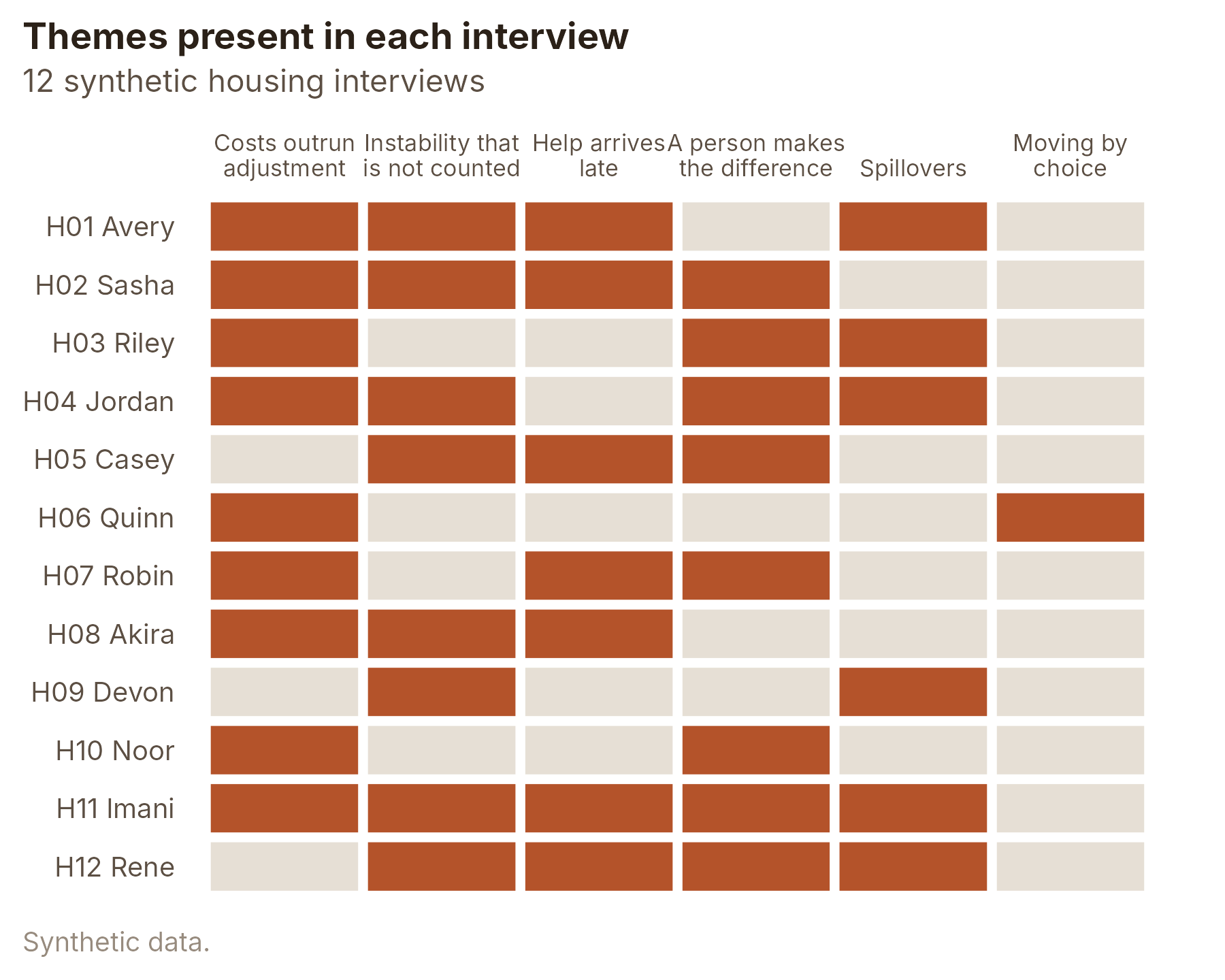
A matrix helps with both steps. A matrix is a table with one row for each participant and one column for each theme. Each cell records whether the theme appears for that participant, often with a short quotation. Ritchie and Spencer (1994) built their framework method around such a table. Figure 7.1 shows the matrix for the housing study.
The matrix shows the analysis in one view. Reading down a column shows who supports a theme. Reading across a row shows one participant’s whole account. Empty cells are informative. A researcher should ask whether a theme is absent for a participant or was only never asked about.
7.7 The Case That Does Not Fit
Row H06 in the matrix stands out. Quinn moved, as most of the others did. Quinn’s interview has almost none of the themes.
A case that contradicts the pattern is a negative case. A researcher who is confident in her themes may want to leave it out. Negative case analysis is the practice of doing the reverse. The researcher searches for cases that do not fit and revises her claims until they account for those cases too.
Quinn says this about the move.
Synthetic “Something we did. That’s the difference, right? We had savings. We had a job that came with us. If I’d had to move because the rent went up and I had two weeks, that’s a different story with the same truck.”
This passage changes the analysis. Before reading it closely, the researcher had used the phrase “people who had to move” to describe her study. Quinn moved and was not harmed by it. The harm that the other participants described did not come from the move itself. It came from a move with no time, no savings, and no say in the matter.
The researcher revises two things. She renames her subject from “moving” to “forced and unplanned moves.” She also adds a condition to her first theme. Costs outrun adjustment for households that have no cushion. Quinn faced the same high rent and had the means to leave on chosen terms.
One case in twelve improved the main claim. If the researcher had dropped it as an exception, the report would have been less accurate.
A second complication comes from Robin, the landlord. An early version of the first theme read “Landlords raise rents faster than tenants can pay.” Robin describes tax and insurance bills that nearly doubled. Robin also keeps one long-term tenant’s rent 200 dollars below the market rate. The theme was reworded so that it describes rising costs and does not assign them to one party.
7.8 Defining and Naming
In phase 5, the researcher writes a short definition of each theme. A definition states the claim, says what the theme covers, and says where it stops. Here is the definition of one theme.
Help arrives late. Participants described help that was available only after a situation had become a crisis. Programs required an eviction notice, a lease, or a place at the top of a long waitlist. People who sought help early were told that they did not yet qualify. The theme covers formal help from agencies and programs. It does not cover help from family and friends, which belongs to the theme A person makes the difference.
A good theme name is short and states the claim. Help arrives late is better than Barriers to assistance, which is a topic. A participant’s phrase can also serve. Imani’s “fine on paper, drowning” would be a strong name for the theme about instability that is not counted.
Most studies of this size report three to six themes. More than that usually means that the themes are still codes. A single theme usually means that it is too broad to be useful.
Finally, consider how the themes relate. In the housing study, they form a sequence. Costs rise. Households without a cushion move into arrangements that are not counted. Formal help is not available at that stage. What changes the outcome is often one person, such as a co-signer, a legal aid lawyer, or a caseworker who checks a list. A short account of how the themes connect is often the most useful paragraph in a report.
7.9 How Many Said It
Table 7.2 reports that 7 of 12 interviews contained the theme Help arrives late. Should a report include such counts?
Researchers disagree. A count helps a reader judge how far a pattern extends within the study. It can also suggest a precision that a small, purposive sample does not have. A reader may take “7 of 12” to mean 58 percent of renters.
A reasonable practice is to report counts in a table and to use careful words in the text. “Most participants” and “a few participants” are accurate when the table shows the numbers behind them. State once, plainly, that the counts describe this study’s participants. Do not convert them to percentages.
Three Signs That a Theme Is Not Ready
The theme’s name is one noun. The theme matches one of your interview questions word for word. You can find only two or three segments to support it, all from the same participant. In each case, return to the codes.
Ethics Moment: Leaving Out What Does Not Fit
A funder hopes the study will show that tenants need more emergency aid. Eleven interviews support that reading. One participant, a landlord, describes costs that make rent increases hard to avoid. A report without her would be cleaner. It would also misstate what the researcher was told. Participants gave their accounts on the understanding that the accounts would be reported honestly. A researcher who reports only the cases that suit a sponsor has broken that understanding with every participant, including those whose words she used.
AI Reality Check: Themes That Fit Any Study
Ask a language model for themes from a set of transcripts, and it will return a tidy list. The themes are often topics, such as “financial strain,” “barriers to support,” and “emotional impact.” These labels would fit almost any study of hardship. A model also tends to describe agreement. It is less likely to notice the one case that contradicts the others. It will rarely report that its own theme is weak. Use a model to suggest groupings you may not have considered. Then do the review yourself. Read every segment under each theme, build the matrix, and search for the negative case. A theme is supported when you have read the evidence for it.
7.10 Putting It All Together
A theme is a pattern across the data, stated as a claim that bears on the research question. A topic can be written as a noun, and a theme needs a sentence. Thematic analysis moves through six phases, from reading to the report.
The researcher sorts codes into candidate themes and then reviews each one. She reads every segment under the theme and returns to the full transcripts. A matrix of participants by themes shows the whole analysis in one view. A negative case is examined and used to refine the claims. In the housing study, one participant who moved by choice showed that the harm came from moves that were forced and unplanned.
A report gives each theme a definition, a name that states the claim, and an account of how the themes connect. Counts describe the study’s participants and are not converted to percentages.
7.11 Looking Ahead
The researcher now has five themes. They rest on her own coding and her own sorting. A skeptical reader may ask how anyone can know that she did not find what she expected to find. Chapter 8 covers the checks that answer that question. One of them is a second coder, and in that chapter the second coder is a language model.
7.12 Further Reading and References
- Braun, V., and Clarke, V. (2006). Using thematic analysis in psychology. Qualitative Research in Psychology, 3(2), 77 to 101. The source of the six phases.
- Braun, V., and Clarke, V. (2022). Thematic Analysis: A Practical Guide. Sage. The authors’ fuller and more recent account.
- Ritchie, J., and Spencer, L. (1994). Qualitative data analysis for applied policy research. In A. Bryman and R. G. Burgess (Eds.), Analyzing Qualitative Data (pp. 173 to 194). Routledge. The source of the framework method and its matrix.
- Gale, N. K., Heath, G., Cameron, E., Rashid, S., and Redwood, S. (2013). Using the framework method for the analysis of qualitative data in multi-disciplinary health research. BMC Medical Research Methodology, 13, 117.
- Maxwell, J. A. (2010). Using numbers in qualitative research. Qualitative Inquiry, 16(6), 475 to 482. A discussion of when counts help.
- Nowell, L. S., Norris, J. M., White, D. E., and Moules, N. J. (2017). Thematic analysis: Striving to meet the trustworthiness criteria. International Journal of Qualitative Methods, 16(1), 1 to 13.
7.13 Key Terms
- Matrix. A table of participants by themes that shows where each theme appears.
- Negative case. A case that contradicts the pattern found in the other cases.
- Negative case analysis. Searching for cases that do not fit and revising claims to account for them.
- Thematic analysis. A method for finding and reporting themes in qualitative data.
- Theme. A pattern across the data, stated as a claim that bears on the research question.
- Topic. A subject that participants talked about, with no claim attached.
7.14 Exercises
Check Your Understanding
- State the difference between a code, a topic, and a theme. Give an example of each from the housing study.
- List the six phases of thematic analysis.
- What are the two steps of reviewing a candidate theme?
- How did Quinn’s interview change the researcher’s first theme?
Apply It
- Turn each topic into a theme by writing a one-sentence claim. Use the corpus for evidence. (a) “Children.” (b) “Landlords.” (c) “Work.”
- Use the file
housing-coded-segments.csv. Pull every segment coded under the theme A person makes the difference. List the people who made the difference and their role in each case. - Write a definition for the theme Instability that is not counted, modeled on the definition of Help arrives late in this chapter. State what the theme covers and where it stops.
Think Deeper
- A second researcher sorts the same 14 codes into three themes in place of five. Is one of you wrong? How should a report handle the fact that another sorting was possible?
- A report states, “58 percent of participants described help that came too late.” The study had 12 participants. What is misleading about the sentence? Rewrite it.
- Robin, the landlord, complicated the first theme. Suppose the study had interviewed no landlords. How would the findings differ, and would the researcher have known what was missing?