Introduction: How Research Works
This book assumes no background in research. This introduction explains what research is, the steps it follows, and where the eight chapters fit. Readers who have conducted a study before can skim it. Readers who are new to research should start here.
Research Starts With a Decision
People in organizations make decisions every day without knowing all the facts. A store owner decides whether to stay open later. A school board decides which program to cut. A county decides where to place a new clinic.
Some of these decisions are small and easy to reverse. Others cost a great deal and affect many people. For the second kind, a guess is a weak basis. The decision is only as good as the evidence behind it.
One example runs through this introduction. It is invented for this book. A community health clinic finds that patients miss 22 percent of their appointments. Each missed visit costs the clinic money and leaves another patient waiting. The director must decide what to do.
She has several ideas. The clinic could send text reminders, add evening hours, or offer rides. Each idea costs money, and she cannot afford all three. Her appointment records show how many visits are missed and by whom. They do not show why. She needs to hear from the patients.
What Research Is
Research is a planned and careful way of producing information to support a decision. Three features separate it from ordinary fact-finding.
- It is planned. The researcher decides what to learn and how to learn it before collecting anything.
- It is systematic. The same care is applied to every case, so one vivid story does not outweigh the rest.
- It is open to checking. The researcher records what was done, so another person can judge the work.
The clinic director could ask the front desk staff why patients miss visits. That is useful, and it is not yet research. The staff hear from the patients who call to cancel. They do not hear from the patients who never call. A planned study would reach both groups.
Many people think of talking with a few people as informal. It becomes research when the three features above are present. The researcher can say why these people were chosen, what they were asked, and how their words were turned into findings.
Research that serves one decision for one organization is applied research. The clinic study is an example. Research that aims to add to general knowledge, with no single decision in view, is basic research. Both kinds use the same methods, and this book serves both.
The Research Process
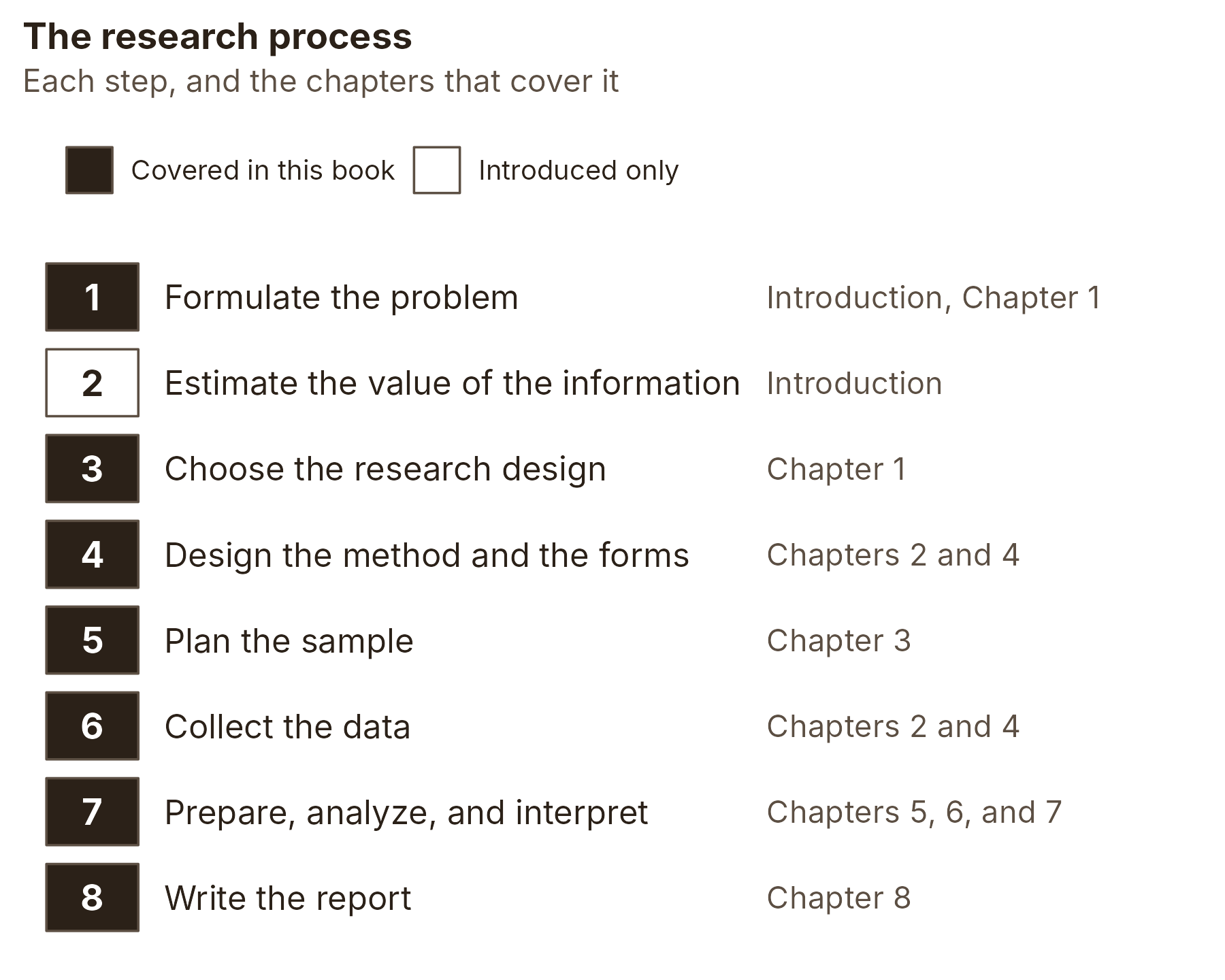
Research is a sequence of steps. Textbooks number the steps in slightly different ways, and the logic is the same in all of them. This book uses eight steps, adapted from Churchill and Iacobucci (2015) and from Zikmund and colleagues (2013).
- Formulate the problem. State the decision and the question that the research must answer.
- Estimate the value of the information. Decide whether the answer is worth the cost of getting it.
- Choose the research design. Decide what kind of study fits the question.
- Design the method and the forms. Decide how to gather the data. In an interview study, the main form is the interview guide.
- Plan the sample. Decide whom to study and how to choose them.
- Collect the data. Conduct the interviews and record them.
- Prepare, analyze, and interpret the data. Turn the recordings into text, label the text, and look for patterns.
- Write the report. Tell the decision-maker what was found and how far it can be trusted.
Each step limits the steps that follow. A leading question in step 4 produces answers that no analysis in step 7 can repair. A sample that left out one kind of person in step 5 cannot be completed in step 8.
In qualitative research the steps overlap more than the list suggests. A researcher often begins to analyze after the first few interviews. What she learns can change whom she interviews next and what she asks. This is a planned part of the method, and Chapter 3 explains how to plan for it.
Figure 1 shows the eight steps and where this book covers each one.
From a Decision to a Research Question
The first step is the one most often rushed. A decision-maker usually arrives with a symptom. The clinic’s symptom is the 22 percent of visits that are missed. A symptom is a sign that something needs attention. It does not say what the cause is.
The researcher and the decision-maker work from the symptom toward a question that a study can answer. Two statements come out of that work.
A decision statement says what the decision-maker has to choose. A research objective says what information would help with that choice. Table 1 shows both for the clinic.
| Decision statement | Research objectives |
|---|---|
| Should the clinic spend its budget on text reminders, evening hours, or rides? | Identify the reasons patients give for missing a visit. |
| Describe what happens on the day of a missed visit, in the patient’s own account. | |
| Learn which kinds of help patients say they would use. |
A useful test for an objective is to ask what the decision-maker would do differently with the answer in hand. If no answer would change the decision, the objective can be dropped.
Is the Research Worth Doing
Research costs time and money. Before starting, the researcher asks whether the information is worth its cost. Four considerations help.
- The stakes. A costly decision justifies more research than a minor one.
- The uncertainty. Research adds the most when the decision-maker does not know which way to go.
- The reversibility. A decision that is hard to undo deserves more evidence than one that can be changed next month.
- The information that already exists. Someone may have collected the answer already.
Data that someone else collected for another purpose are secondary data. Data collected for the study in hand are primary data. A careful researcher looks for secondary data first. Text can be secondary data too. Chapter 8 uses 1,000 complaints that consumers sent to a federal agency, and no researcher asked for them.
Three Kinds of Design
A research design is the overall plan for a study. The right design depends on how much is already known about the problem. There are three main kinds.
Exploratory research is for a problem that is not yet understood. The researcher does not know which questions to ask. The methods are flexible, and the samples are small. The clinic could begin by interviewing 15 patients who missed visits.
Descriptive research is for a problem that is understood well enough to measure. It answers questions about how many, how often, and who. The clinic could survey 400 patients to learn how common each reason is.
Causal research tests whether one thing produces a change in another. Its main tool is the experiment. The clinic could send reminders to a randomly chosen half of its patients and compare missed visits in the two halves.
Many projects use all three in that order. The interviews show which reasons exist. The survey shows how common each one is. The experiment shows whether a remedy works.
Qualitative research is the usual tool for the first kind. It also has a place after the other two. A survey can show that younger patients miss more visits and leave the reason unexplained. Interviews can then supply the explanation.
Words and Numbers
Research data come in two broad forms. Qualitative research collects words, such as what people say in an interview. Quantitative research collects numbers, such as answers to a survey with fixed choices. Table 2 compares them.
| Qualitative research | Quantitative research | |
|---|---|---|
| Typical question | Why, and how | How many, and how much |
| Questions asked | Open, with follow-up | Fixed, the same for everyone |
| Sample | Small, chosen for what each person can explain | Large, chosen to represent a population |
| Data | Words | Numbers |
| Analysis | Reading, coding, and comparison | Counting and statistics |
| Common use | Exploratory research | Descriptive and causal research |
Neither form is better than the other. Each answers a different kind of question. A study that uses both is a mixed methods study.
The two forms also support different claims. Fifteen interviews can show that a reason exists and how it works in a person’s life. They cannot show what share of all patients have that reason. Chapter 1 returns to this limit, because most misuse of qualitative research comes from ignoring it.
This book covers qualitative research. Its companion, Before the Numbers, covers quantitative research. Each book can be read without the other.
The People Involved
Three parties take part in most studies, and each has duties to the others.
- Participants give their time and their words. They are owed an honest account of the study, a free choice about taking part, and protection of what they share.
- The researcher owes the sponsor careful work and an accurate report, including results the sponsor did not hope for.
- The sponsor is the person or organization that asked for the study. The sponsor owes the researcher an honest statement of the decision and must not ask for a result fixed in advance.
These duties weigh more in qualitative research. A participant’s own words can identify her even when her name is removed. Chapter 4 covers consent and confidentiality, and every chapter has an Ethics Moment.
What This Book Covers
This book follows the research process from the first question to the written report, for studies that collect words.
- Asking and Listening. Chapter 1 explains what qualitative research can and cannot show. Chapter 2 covers the interview.
- Participants and Trust. Chapter 3 covers whom to interview and when to stop. Chapter 4 covers consent and confidentiality.
- From Text to Themes. Chapter 5 covers coding, which is the labeling of text. Chapter 6 covers how labels become findings.
- Evidence and Reporting. Chapter 7 covers how to check an analysis. Chapter 8 covers text that already exists and the written report.
Two topics are left to other books. Surveys, sampling for surveys, and experiments belong to Before the Numbers. Statistical tests belong to Margin of Error, the statistics book in this series.
Each chapter opens with a note that names the step of the process it covers. Chapter 1 begins with a school district that is losing students and a survey that could not say why.
Key Terms
- Applied research. Research that serves a specific decision.
- Basic research. Research that aims to add to general knowledge.
- Causal research. Research that tests whether one thing produces a change in another.
- Decision statement. A statement of what the decision-maker has to choose.
- Descriptive research. Research that measures how many, how often, and who.
- Exploratory research. Research on a problem that is not yet understood.
- Mixed methods. A study that uses qualitative and quantitative research together.
- Primary data. Data collected for the study in hand.
- Qualitative research. Research that collects words.
- Quantitative research. Research that collects numbers.
- Research. A planned and careful way of producing information to support a decision.
- Research design. The overall plan for a study.
- Research objective. A statement of the information that would help with a decision.
- Secondary data. Data that someone else collected for another purpose.
Further Reading
- Churchill, G. A., and Iacobucci, D. (2015). Marketing Research: Methodological Foundations.
- Zikmund, W. G., Babin, B. J., Carr, J. C., and Griffin, M. (2013). Business Research Methods (9th ed.). Cengage.